Introduction: Why Paid Advertising Matters for Serious Affiliate Marketers
Organic content, SEO, and social media are valuable for initial audience growth, but they can take months to deliver results. For affiliate marketers who want faster traction, predictable traffic, and scalable revenue, paid advertising is one of the most effective strategies. When executed strategically, paid ads allow affiliates to target high-intent audiences, test offers quickly, and scale campaigns with measurable performance metrics.
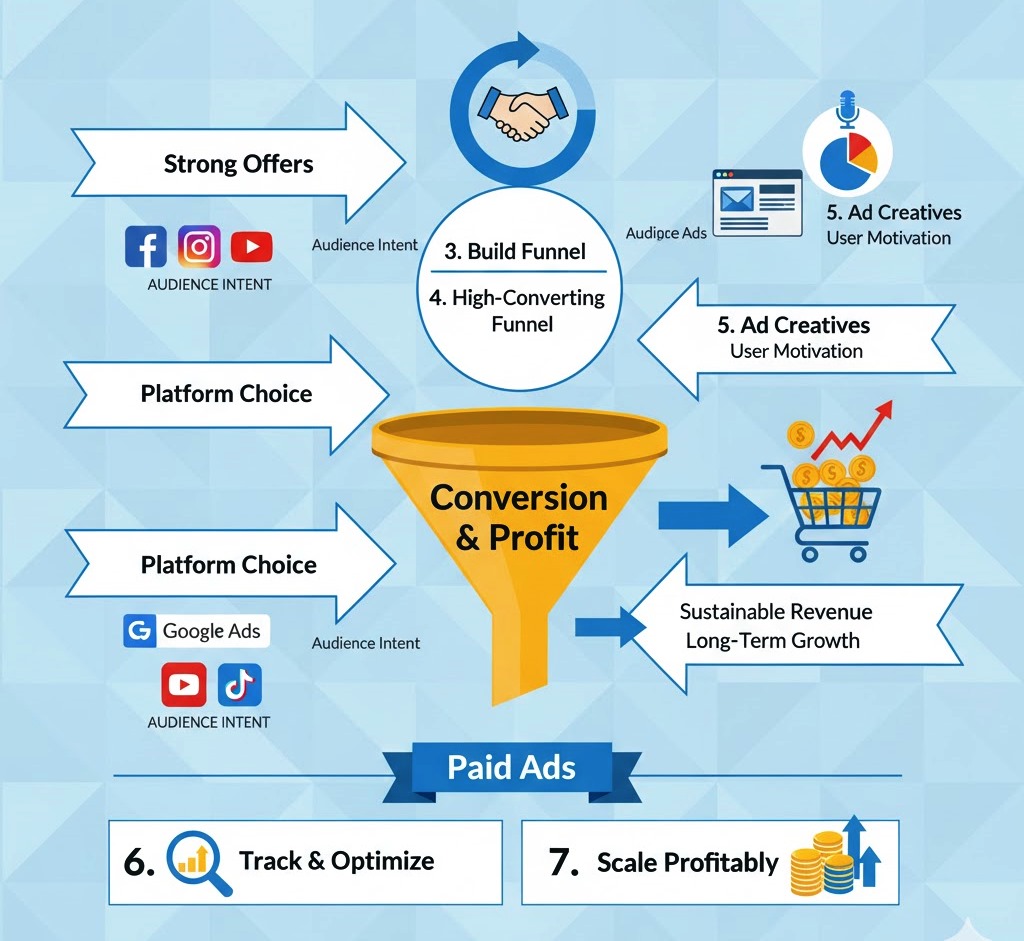
However, paid ads can also be expensive and risky if approached without structure. Rising competition, stricter ad policies, and unpredictable market behavior make “guesswork advertising” unsustainable. Affiliate marketers must rely on data-driven strategies, strong offers, and optimized funnels to generate profitable ROI. This article outlines a professional, systematic approach to using paid ads to scale affiliate earnings efficiently and sustainably.
- Choose the Right Platform Based on Audience Intent
Every advertising platform has strengths and limitations. Selecting the right channel depends on the product, target audience, and budget.
Common platforms for affiliate marketers include:
- Google Ads – Targets users actively searching for solutions
- Facebook/Instagram Ads – Ideal for awareness, interest building, retargeting
- YouTube Ads – Strong for tutorials, reviews, high-ticket offers
- TikTok Ads – Fast reach, low cost, suitable for trending niches
- Native ads – Good for long-form content and advertorials
The best choice is not the cheapest, but the platform that matches buyer intent. For example, if your product solves a problem users are already searching for, Google Ads may outperform social ads because demand already exists.
- Promote Offers with Strong Conversions and Solid Payouts
Paid advertising magnifies both success and failure. Weak offers will drain budget quickly, regardless of ad quality. Ideal affiliate offers for paid traffic should have:
- High conversion rates
- Attractive commission structure
- Proven sales funnel
- Strong market demand
- Existing testimonials or social proof
Avoid promoting low-ticket offers unless you are highly experienced with low-margin scale advertising. High-ticket products, subscription services, and recurring commissions are typically better suited for paid ads.
- Build a Simple, High-Converting Funnel
Sending traffic directly to an affiliate link rarely works. Instead, paid ads perform best when paired with an optimized funnel designed to pre-sell the audience. Common funnel structures for affiliates include:
- Landing page → Product page → Purchase
- Lead magnet → Email sequence → Offer
- Advertorial → Product review → Offer
Your funnel should:
- Capture attention quickly
- Address pain points clearly
- Present benefits before features
- Build trust with social proof
- Guide users toward one action
A strong funnel does not need to be complex. It needs to remove friction and increase clarity.
- Craft Compelling Ad Creatives Based on User Motivation
Successful advertising is not about aggressive selling—it is about strategically aligning with the audience’s goals. Effective ad creatives typically highlight:
- The problem
- The desired outcome
- The solution (your product)
- A clear call to action
High-performance ad angles often include:
- Urgency or time-sensitive opportunity
- Cost-savings or simplicity
- Success stories and real outcomes
- Emotional triggers such as confidence or freedom
Focus on messaging that promises value, not hype. Professional tone builds trust more effectively than exaggerated claims.
- Start with Precision Targeting, Then Broaden
Paid advertising allows precise audience targeting, but over-narrowing can increase costs. A sustainable approach is:
- Start with defined targeting
- Identify profitable segments
- Expand reach gradually to reduce cost
Key targeting factors include:
- Interests and behaviors
- Demographics
- Keywords (for Google Ads)
- Retargeting website visitors
As campaigns generate data, shift from interest-based targeting to behavior-based targeting, which is more accurate and profitable.
- Track Key Metrics and Optimize Relentlessly
Paid advertising is a continuous optimization process. Essential metrics include:
- Cost per click (CPC)
- Click-through rate (CTR)
- Conversion rate (CVR)
- Customer acquisition cost (CAC)
- Earnings per click (EPC)
Profitability depends on managing these numbers—not guessing. Small improvements in CTR or conversion rate can dramatically increase ROI.
Example:
- Improving CTR from 1% to 1.5% can reduce costs by 33–40%
- Improving CVR from 2% to 3% can increase revenue by 50%
Data, not creativity, drives profitability.
- Scale Profitably by Reinforcing What Works
Once an ad set consistently produces profit, scaling becomes possible. Scaling strategies include:
- Increasing daily budgets gradually
- Duplicating winning ad sets
- Expanding geographic reach
- Testing new creatives with the same audience
Avoid scaling too quickly. Sudden budget jumps can break the algorithm and increase costs. The goal is consistent, predictable growth.
Conclusion: Paid Advertising Is a Powerful but Disciplined Approach to Affiliate Growth
Paid advertising offers immense potential for scaling an affiliate business, but success depends on strategy, not luck. By choosing strong offers, building optimized funnels, understanding audience intent, and analyzing performance metrics, affiliates can achieve faster results and higher revenue than organic methods alone.
With the right process, paid ads turn from an expense into a predictable engine for long-term profit.